Bloggers

Een overzicht van blogs geschreven door aanbieders die zich hebben aangesloten bij e-Learning.nl.


Ingaven voor 'Kasper Spiro'

Van Kasper Spiro | 13-12-2021 | Article Rating | (0) reacties

I’m stepping aside as the CEO of Easygenerator

I have decided that I will step aside as CEO of Easygenerator. Starting January 1, 2022, I will become the company’s Co-founder and Chief Learning Strategist instead. Let me explain.  

This past December first marks 11 years since I became the CEO of Easygenerator. In these 11 years, I have played my role in bringing the organization to where it is today. In this period we switched the tool from an instructional design tool to a tool for employees based on our Employee-generated learning approach. We moved to a pure SaaS model: a 100% cloud-based and a 100% subscription-based. We switched from selling via a network of partners to a direct selling approach. We changed everything except the name Easygenerator.  

And this paid off. We are now a fantastic organization of more than 100 people, with customers from over 50 countries. Our revenue is over 9.000.000, and it is still snowballing.  We have offices in Rotterdam, Zhytomyr, Dubai, and Medellín, and even more, people scattered around the globe. We’ve become an amazing place to work, with a unique team that is incredibly diverse and has an amazing culture. We have a product that delivers great value to our customers, and we have unprecedented customer support.   

I’m so proud of what we have achieved. The next step in Easygenerator's ambition is to grow to a revenue of 100 million, which means we’d need around 1000 people. While I’m excited about where we are heading, I’m unsure if I’m the right person to lead the company in this next phase. On top of that, I’m sure that I would not enjoy leading this process. It is not where my heart is; it is not where my strength is.  

When I look at the work I’ve done, there are some activities I like more than others. I love working on the company’s vision and translating that into the product’s direction. I love thought-leader activities like writing, presenting, hosting the podcast, and leading webinars. I love the conversations I have with our customers: challenging them, helping them, informing them.  

These are the things that I want to spend more time on, and that is precisely what I will be doing. I’m focusing on the things where I can bring the most value, and those things happen to be the things that I like most — the things that give me energy.  

We decided that Jan-Kees de Jager will become the new CEO of Easygenerator. He has been a shareholder at Easygenerator for 17 years now. In the last two years, he was more closely involved as the president of our board. He and I are 100% aligned on the goals and direction of Easygenerator. He is the perfect person to lead the company into its next phase of growth.  

I’m looking forward to focusing on those elements of my work that allow me to bring my unique value to the company, the employees, the product, and our customers. It also means I do plan on writing more often on this blog next year, so you will be hearing more from me. 

Kasper Spiro stepping aside as CEO of Easygenerator

Lees verder
Van Kasper Spiro | 23-04-2021 | Article Rating | (0) reacties

Easygenerator: a great place to work and grow

When we started building Easygenerator back in 2013, we had a vision about our product, but we also had a clear idea about what kind of company we wanted to become. We knew that it is the people that make your company; they define the heart and soul of the company.

Now, eight years later, we are the company I hoped to become. We are a group of 83 people with very different backgrounds, but all very committed to Easygenerator. We focus on bringing real value to our customers with a great product, great vision, great support, and above all, a great team.  

We are highly international. Although we have Dutch roots, we went global from day 1. We launched our product at a conference in Las Vegas, and the USA is our biggest market. We have customers in over 50 countries. We have offices in Dubai, Rotterdam, Zhytomyr, and Colombo.

In the early days of Easygenerator, when we wanted to hire our first salesperson, we put a Dutch ad online and got Dutch applicants whose first question was: What kind of company car do I get? That is not how we work. Our product is 100% SaaS, and we sell online, we guide our customers online, everything is online. To reach a wider audience, we changed the ad into English, with the title: "Salesperson wanted (no company car)." We added that you need to be fluent in English and that you do not have to speak Dutch at all. With this, we got very different candidates. As a result, our Rotterdam team is now 33 people and counts 17 nationalities.

Last year we grew our revenue by 93%. Growing at this pace opens up opportunities for growth for our employees. Last quarter, three of our BDRs got promoted. One became a marketeer, one a Customer Success Manager, and the third one is now an Account Executive.

As the CEO of the company, I guard our values. I promote them constantly, and I will interview every candidate myself, checking if they are a fit for our company. Our values are:

  • Challenge
    • We opened up a new market with our Employee-Generated Learning approach. Most things we do are new, and we know we can do them better. We want every employee to challenge the status quo if they think we can improve on it.
  • Experiment
    • We develop our software in an agile way with a new release of the product every week. Small stepssmall iterations—are key. We use this experimental approach in everything we do, from marketing to customer support and everything in between.
  • Own
    • We are a results-driven organization. That means we need you to be responsible for your targets. That allows us to stay away from micromanagement and, instead, manage you on your output.

We found a fantastic way to pay attention to these values. We created cards with an inspirational quote from a famous person; we have eight different cards per value. You can celebrate a colleague who acted according to that value by giving them the corresponding card. We use a Slack channel (#valuerecognition) for this. That way, you can share the value story and the recognition with everybody. It looks like this:
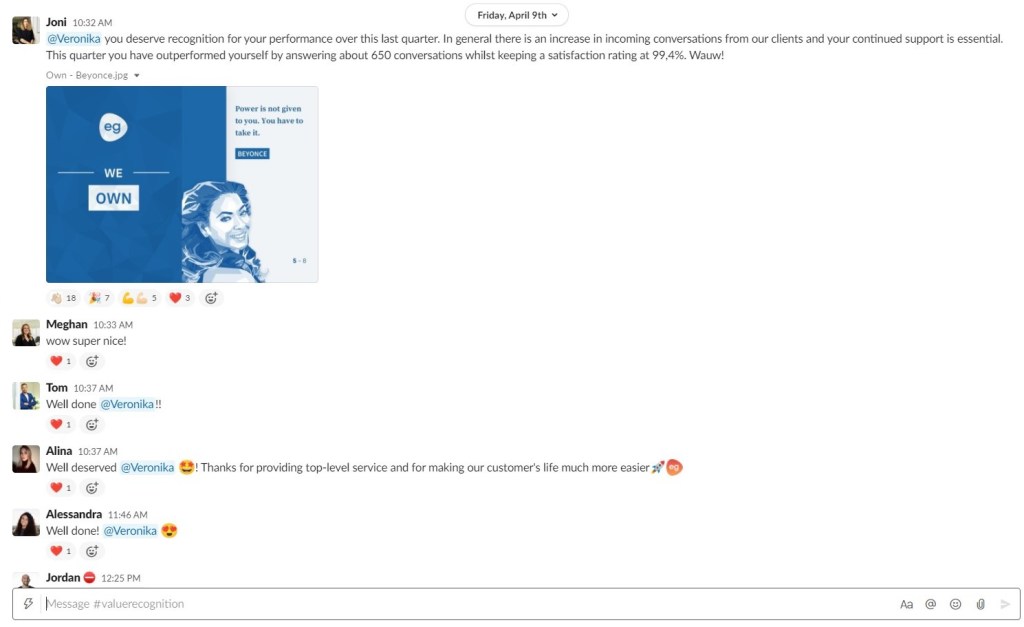
I like this a lot; it is just an illustration of the way we do things. I believe there is something like an Easygenerator vibe. I recently visited our Dubai office for the first time. It was a super cool experience, to travel for almost 7000 kilometers to a country I had never been before, and then to enter an office with that familiar Easygenerator feeling that made me feel at home instantly.

If you want to experience this yourself firsthand, come and join us. We are hiring in Dubai, Rotterdam, and Zhytomyr. Check out all the vacancies and apply for the one that fits you!

Easygenerator is hiring! We are looking for:

 Business Development Managers, Account Executives, Front- and Back-End Developers,
designers, marketeers, recruiters, Customer Success Managers, Onboarding Specialists,
support agents and other great talent!

Lees verder
Van Kasper Spiro | 25-02-2020 | Article Rating | (0) reacties

Smarter ways to improve the quality of Employee-generated Learning

Many thousands of subject matter experts (SMEs) capture and share their knowledge in the form of a course or assessment using Easygenerator. As we are working closely with our customers, we gained new insights about how to manage and improve the quality of the content in a smarter way.

Old school quality control

When companies start with Employee-generated Learning there is always a concern about the quality of the content. The fear is that SMEs will create ineffective content because they do not have any Instructional design or didactical knowledge. And the initial reflex is often: control. They forbid subject matter experts to publish. Instead, SMEs have to send their courses to someone (or some controlling committee) for control. They will decide if the quality is sufficient or not and publish the content into the LMS. 

Faster and more cost-effective

Increased speed of development and decreased costs are two of the most important drivers behind Employee-generated Learning. Having SMEs create learning content is way faster and cheaper than the old school centralized way of content creation. But if you decide to build-in a quality check process you will take away this advantage.

It is all about responsibility

The biggest benefit of Employee-generated Learning is that it will help you to keep your content up-to-date. SMEs are responsible for content creation and maintenance. If something changes in the business or when SMEs gain new knowledge or insights, they can quickly update the content. This ensures that the content is always up-to-date and accurate. Formal control checks would undermine this responsibility and disturb the process.

New ways to improve the quality of the content

By working with our customers, we found a couple of ways that will allow you to have high-quality content and at the same time keep the benefits of Employee-generated Learning.

Show the authors name

The first one is really simple. Make sure the name of the author is clearly visible in the course. When their name is so clearly attached to the content, people will think twice before putting out bad content; their name is on the line after all. 

“We also found that learners are more likely to share their feedback with a named author than with an anonymous author.”

You can ensure quality from L&D, by checking if the author’s name and contact details are clearly stated in the course. 

Wikipedia effect

Consider publishing your employee-generated content somewhere else than in your LMS. An LMS is a formal top-down controlled environment, it does not naturally invite feedback. Feedback from the learners is indispensable in improving the quality of the learning content. With many social learning platforms, learning experience platforms or even with collaboration and knowledge sharing platforms it is way easier to publish something and respond to it. They are built with a feedback loop in mind.  You need this feedback in order to get what we call the “Wikipedia effect’. Because so many people read the content and respond to the content with suggestions and improvements, the quality will improve significantly. That is what you want to enable.

The Google effect

Most social learning tools have a search option as the main way of finding content. Good content, because it is read and shared frequently, will rise in the search results where it will be found easily. Bad content, on the other hand, will not be read or shared, and so will not appear high in the search results, disappearing into the mass. A quality check without any extra effort.

Bonus: Combining top-down and bottom-up content creation

Here is an overview of the process. An author (the SME to be more specific) publishes a course onto a social learning platform or LXP with his name clearly attached to it. He gets feedback from the learners and improves his content based on that.  And now the bonus part comes into play. 

The learning department can cherrypick from the Employee-generated Content. By selecting the best courses from the pool and upgrading them with the SME to official company-approved content they can get a lot of high-quality content for the formal LMS with very little effort. Please do make sure the SME stays responsible for the “official” course, otherwise, you will lose your benefits.

Lees verder
Van Kasper Spiro | 14-11-2019 | Article Rating | (0) reacties

A helicopter view on our changing learning landscape

Learning quadrant with text by Kasper Spiro

Being the CEO of a company that revolves around learning technology I have to watch the trends in Learning & Development. I even have to predict what will be next. I need to be ahead of the game in order to steer my company in the right direction. For this purpose, I made an analysis of the changes that I see and I wanted to share these insights.

Move towards informal learning

This trend started a long time ago with Jay Cross, with his “workplace learning” approach. This was followed by the “70:20:10” trend and is now further enforced with the “Five moments of learning needs”. All these theories are telling us that informal learning is more important than learning, and that performance or behavior is more important than learning.

The learner is taking control

The times that a company could tell an employee how to develop and what to learn are over. A modern-day employee will set his own route into the future, and determining what, where and when to learn is a part of this. Because of this, the old top-down approach of the L&D department is not working anymore. It is all about facilitating the learner now, thus moving to a bottom-up approach. 

Performance over learning

Learning used to be about transferring knowledge, that is no longer the case. Knowledge and facts can be Googled. Teaching people this knowledge is not effective anymore. Teaching them where to find this knowledge is step one. But the trend is towards making this knowledge available in the context of the work, in order to improve performance.

From knowledge to skills

Having the knowledge available at your fingertips in a performance support environment is one thing, but we need to teach people what to do with that knowledge, how to change their behavior. It is not about knowledge anymore it is about skills that apply that knowledge in order to increase performance

My learning quadrant 

I have combined these four trends into what I call my “Learning Quadrant”.

Learning quadrant with text by Kasper Spiro
A learning quadrant for the prediction of change in the world of learning

In this quadrant, I have plotted the four areas of Learning and Development. Interestingly enough you see all the trends moving away from the “formal” quadrant to informal, skills, support and bottom-up. 
The main shift at this moment is a move from top-down to bottom-up. This explains the decrease of interest in the (top-down) oriented Learning Management Systems and the increased interest in Learning eXperience systems. It is still about learning and knowledge though.

Learning Quadrant with explanation of quadrants by Kasper Spiro

I believe that moving from formal learning towards knowledge sharing is just an intermediate step. All the main trends indicate that it is all about performance and performance support in the long run. That is where we are heading as an industry.

Lees verder
Van Kasper Spiro | 29-10-2019 | Article Rating | (0) reacties

#Learning2019 Day 3. Burger universities, Elliot, Nigel, Bob and Donald

This morning started with an extra "Dutch" session by Rob Lauder, the CLO of Mc Donalds. He gave us a detailed overview of the setup of Mc Donalds training programs. They employ 1.9 million people and they have 1 million new hires every year. Mc Donald knows that for crew employees they will be their first job and they will move on pretty soon. Their training program is focus on this, making sure their employees are ready for their next job. Pretty cool.

Rob Lauber presenting at Learning2019
My notes on Rob's presentation (click to enlarge)

Elliot Masie and Nigel Paine did a session together on Re-imagining learning. Sharing stories and insights with us and answering questions. They paint a nice picture of a discipline that is fundamentally changing

Re-imagining learning Elliot Masie and Nigel Paine (click to enlarge)

Nigel Paine also did a session on his new book on Learning cultures. he developed a cool model and a guide how to use it. I only have this bad photo of the model. Definitely a book I'm going to read.

Nigels model

Bob Mosher did (half a) Keynote. Repeating the things he said in the other sessions, but also interviewing Katie Coates and Mark Wagner.

Bob Mosher at Learning 2019

The final general session of the day was hosted by Donald Taylor called rethinking L&D. Here is my summary

My notes on Donalds general session (click to enlarge
Lees verder
Van Kasper Spiro | 29-10-2019 | Article Rating | (0) reacties

#Learning2019 Day 2. About performance support and the future of learning…

The second day of Learning 2019. A full packed schedule with many sessions, keynotes, planned and unplanned meetings.

Today started early at 6.45 with an extra "Dutch session" by Molly Petroff from the St Vincent Hospital. Molly is a workflow specialist already for 12 years. She showed us how they got started and what they have learned along the way. They created based on the main processes in the hospital, a performance support environment using the five moments of learning need. For me, as a "tool man" I could not help noticing how simple the tooling is they use. It is a reference guide. They have used the work process to organize the content and create some context. It also became apparent to me that maintaining the content is at least as big of a problem as it is with learning.

I continued with performance support and the 5 moments of learning need with a session by Conrad Gottfredson and Bob Mosher

Bob and Con's session at Learning 2019 (click to enlarge)

One of my main learnings was the performance support pyramid. Or maybe I should say rememberings because I did know it, but I forgot how powerful it is. It is a complete guide to create performance support content

The performance support pyramid (By Conrad Gottfredson)

The next session was the Keynote by Elliot Masie. It was full of energy but I liked his small session from Sunday much more

Elliots keynote

I attended a session on "Creating effective micro learning" by Karl Kapp. He sees micro learning more as performance support tool. Main take-away for me where the 6 types of micro learning.

Karl Kapp on micro learning (click to enlarge)

The last session I want to report on is the keynote from Richard Cullata. He gave as his view on the future of learning with a number of interesting guests. I liked this session. Joseph South had probably the most fun part debunking "neuromyths":

  1. Learning styles do not exist (learning preferences do)
  2. We use only 10% of our brain capacity. Not true we use our full brain everyday
  3. The split between the left and right brain with specific functions is also a myth.
Richard Calutta session (click to enlarge)
Lees verder
Van Kasper Spiro | 27-10-2019 | Article Rating | (0) reacties

Brandon Carlson on how we live, work and learn

Brandon shared the insights he learned as a learning manager at Home Depot and Delta on living, working and learning

Kasper's mind map on Brandon Carlson (click to enlarge)

Lees verder
Van Kasper Spiro | 27-10-2019 | Article Rating | (0) reacties

Dutch session by Donald Taylor at #learning2019

Donald Taylor is (among other things) the Chairman of the Learning and Performance institute. David discussed the trends that emerge from the surveys they do.

Kasper's mind map on the trends and megatrends by Donald Taylor (click to enlarge)
Lees verder
Van Kasper Spiro | 27-10-2019 | Article Rating | (0) reacties

Bob Mosher’s Dutch session at #learning2019

Bob Mosher did an exclusive Dutch session this morning at Learning 2019

Bob presenting
Bob became very passionate when explaining the difference between learning in or while working and made a strong point that for workplace learning it is Learning while working.
Kasper's mind map on Bob Moshers session (Click to enlarge)

Lees verder
Van Kasper Spiro | 27-10-2019 | Article Rating | (0) reacties

Elliot Masie Dutch Session at #learning2019

At Learning 2019 there is a separate extra track for a group of 45 Dutch learning people. I was allowed to join their sessions. The first session was with Elliot Masie. Elliot sold the event last year, but at 69 he is still amazing.

Elliot presenting at Learning 2019 for the Dutch group

Eliot started by showing his presentation, which was just this slide:

Elliots trends

I made my notes during this session in this mind map:

Kasper's notes of Elliot Masies Dutch session at Learning19us (click to enlarge)

Lees verder
Van Kasper Spiro | 27-05-2019 | Article Rating | (0) reacties

How subject matter experts can create more effective learning

An increasing number of subject matter experts are sharing their knowledge in a variety of ways. One of them is the creation of learning content. Facilitating this is the core role of my company Easygenerator. We provide a hassle-free authoring platform for them to share knowledge effortlessly. We know that the software must be so intuitive that anyone can log in and, without any training, can start creating learning material. We also know that we have to guide and assist subject matter experts to help them create effective learning materials. Subject matter experts often start with what we call a “PowerPoint mindset”; they are focussed on transferring the information as if they are creating a PowerPoint presentation. As a result, subject matter experts often create very content heavy courses that are not effective learning materials. In this blog, I will give some tips on how to change this mindset and with that help subject matter experts to create better and more effective learning.

Moving away from a PowerPoint mindset

The main problem with the “PowerPoint mindset” is the focus on content. Because of this focus, most subject matter experts will just start with writing. They will pour out all the knowledge they have in order to share it. While their intention is great, this does not lead to effective learning material. They will create content heavy courses that are not engaging or effective.
  • Set a goal: The start of the process should be setting a goal, or a learning objective combined with determining your audience. This will give you a first indication of which knowledge you have to share and will give you more focus.
  • Define the questions: As a second step, you need to determine how to assess these objectives. What kind of questions or assignments can you give the learner, so they can prove that they have achieved the learning goal.
  • Create focussed content: The third and final step is creating content. But with one important limitation: only create content that the learner will need in order to answer the questions or do the assignment.
We found that with this simple approach courses will be between 40% and 60% smaller. The time to create the materials will be proportionately less and a higher percentage of learners will complete the course. Courses created in this way will be rated significantly better than courses created with a PowerPoint mindset. [caption id="attachment_6781" align="alignnone" width="1394"]Goal - Assessment - Content A simple didactical approach for SME's to make their learning material more effective[/caption]

Beating the forgetting curve and enabling microlearning

The other thing that will have a big impact on the effectiveness of the materials is to create a series of small learning nuggets with a repetitive pattern. I will first explain why. In 1885 the psychologist Ebbinghaus discovered that you will forget most information you learned within a matter of hours. When you receive new information you will store it in your short term memory. But that memory has limited capacity. New information needs to be stored there and therefore your brain needs to remove “older” information. Only information that is transferred to your long-term memory will be saved, the rest is lost. Research shows that you will lose over 90% of that new information. This is called the forgetting curve. One of the most effective ways to beat the forgetting curve is repetition. forgetting curve When you are repeating the information you have better retention that can go up from 10% to 90%. There is a second element to consider, that is that shorter e-learning courses tend to be more effective than long ones. These short courses are called learning nuggets or microlearning. If you combine these two you get a really interesting solution. The rules are simple:
  1. Create courses that will take no longer than 15 minutes to complete.
  2. Build a series of them, making sure every course repeats parts of the previous one
In Easygenerator, for example, we have a feature that will show a page to the learner based on his result (fail or pass). On this page, you can include a link to the next module of the series. This way you can build a string of learning nuggets with repetition built in to beat the forgetting curve.   Lees verder
Van Kasper Spiro | 27-02-2019 | Article Rating | (0) reacties

Best practice instead of malpractice

Last month, I required a surgical intervention during which my worn-out shoulder was replaced with an artificial one. During the final preparations, one of the medical staff asked me which shoulder I needed to be operated on and I told her it was the right-hand side. She then got a marker pen out and drew a big arrow on my right forearm pointing towards the shoulder. This was to make sure I had surgery on the correct shoulder, I immediately loved the effectiveness of this solution. By delegating the decision on which arm to draw the arrow to me as the patient, the hospital also more than likely covered itself against a future malpractice claim. A solution brilliant in its simplicity. After doing a little more research, I discovered there’s actually a term called Wrong Side Surgery or WSS. It refers to surgical operations performed on the incorrect side of the body. Although I couldn’t find out the exact origins of the excellent marker pen solution (leave me a comment if you happen to know), I still think it’s one of the ‘best’ best practices that I’ve come across. I love it! These best practices are crucial ingredients when it comes to performance and workplace learning. The way Easygenerator allows informal knowledge to be shared across organizations makes sure that internal best practice is captured and spread as effectively as possible.   Indeed, along with its content curation facilities, gathering best practices is one of Easygenerator’s top features when it comes to informal learning. It provides subject matter experts with a powerful tool for sharing their knowledge in the easiest and quickest way possible. Drawing an arrow on my forearm was certainly simple and fast. But most importantly (and thankfully!), it was also extremely effective – exactly the type of best practice Easygenerator wants to help capture. Lees verder
Van Kasper Spiro | 07-01-2019 | Article Rating | (0) reacties

Employee-generated Learning is now mainstream

The main takeaway for me looking back on 2018 is that our approach of Employee-generated Learning (EGL) is becoming more and more mainstream. Let me explain why this is the case. Knowledge sharing, social learning, and peer-to-peer learning have become household names driving new knowledge acquisition in the workplace. Most research such as Udemy’s Learning Trends, E-learning Guild’s Predictions, Jane Hart’s Annual Survey, Expert Economy Author’s Insights and so on emphasizes the importance of these learning models. This reinforces their growing demand within the Learning industry.   As EGL is rooted in this sphere of learning models, this emphasis by big players is clear evidence of acceptance and adoption of our approach.

Healthy Competition

Easygenerator started pioneering the Employee-generated Learning approach in 2013. We have been championing this model ever since and have become more and more successful with our growing clientele. We now have over 1,000 customers in 70 countries. This success attracts attention and competition. In 2018, we noticed competitors entering the league of EGL. They try to offer products and services similar to Easygenerator’s. I see that as a compliment and as proof that our approach is maturing rapidly.

No fewer than 3 awards

CLO Award

We won the golden “Excellence in e-Learning” award at the 2018 CLO Learning in Practice Awards, presented by Chief Learning Officer magazine. This award was specifically awarded for how we implemented our Employee-generated Learning model at Nielsen. Screenshot_1

Brandon Hall Award

We won the “Best Advance in Content Authoring Technology” award by Brandon Hall. This one was awarded for the “Easygenerator enterprise plan for Employee-generated Learning” and for our product innovation in creating a subject matter expert-friendly learning tool. Screenshot_3.png

MVP Award

We won a third award for an article titled “Tight Budgets and Small L&D Teams? Time to Embrace Employee-Generated Learning.” The article was published in Training Industry magazine. It describes how the Employee-generated Learning approach will boost your productivity. In addition to this award, most L&D magazines and blogs such as CLO, ATD, Jane Hart, the E-learning Guild, Training Industry and STADA welcomed our articles and insights on the topic of EGL, which attests to the L&D community's growing interest in this trend.

DevLearn presentation

I presented this year at the DevLearn Conference in Las Vegas. The topic was “Multiplying Your L&D Capacity with Employee-Generated Learning.” I got such a huge response that we decided to repeat the presentation in webinar form in collaboration with the E-learning Guild and Aggregate. Here is the recording of that last webinar: https://vimeo.com/304452509

Easygenerator’s growth

And for me, the growth of my company Easygenerator is, of course, an important indicator. This year, we welcomed over 500 new customers (and the year is not over yet), bringing our total number of customers to more than 1,000. We also see significant growth among the customers who joined us before this year.

Quality and service

There is more to success than just the concept. Our product has scored an NPS of 53. The average for cloud-based software is around 30 and the best-performing software companies score around 55. Our 53 is out of this world and indicates that both our product and our services like customer support are on a very high level. If our Employee-generated Learning approach was not solving a real business problem, we would not be so successful. I believe that we are only at the beginning of reaching our potential, so I’m very much looking forward to 2019.   Lees verder
Van Kasper Spiro | 11-12-2018 | Article Rating | (0) reacties

Moving learning back to the business

Moving learning back to the business Learning has become too far detached from the business side of companies. In the days of medieval guilds, you would complete your entire education while working and learning the trade and skills alongside a master craftsman. However, times have changed and we've moved learning to schools and universities. At work, corporate HR/learning professionals are responsible for employees' learning and development. I believe this is wrong for many reasons. We need to move learning back to the business. In this blog post, I address a couple of problems I see stemming from the disconnect between learning and the business and discuss some positive trends for the future. Artboard Cost and speed The development process for learning content is complex, slow and expensive because the people who have the knowledge (subject matter experts/SMEs on the business side) aren't the ones creating the content. Companies hire learning specialists and instructional designers to create the training courses. This means knowledge has to be transferred from the business to the learning and development (L&D) department. All the content has to be checked and doublechecked before a course is ready to go live. Maintenance Learning specialists are normally responsible for maintaining the published content, but they don't work on the business side. That means they are unaware of real-time changes affecting the business. As a result, courses often remain outdated. What does this really mean? Organizations end up spending time and money equipping their employees with irrelevant/outdated knowledge and skills. Disconnect from the business The root cause of these problems is the fact that L&D is detached from the business. It's as if there's a wall between the L&D professionals and the SMEs who are working on the business side. This slows down the process of creating learning content and makes it expensive and impossible to maintain. I believe we must make the business side responsible for content creation and maintenance so that learning is fully aligned with and integrated into the business. Trends To counteract these problems, I see multiple trends in corporate learning, all of which point learning in the same direction: toward the business Informal learning and workplace support It's clear that informal learning and workplace support are becoming more important. Trends or hypes like 70:20:10, five moments of learning need, and many others all point in that direction. This shows that learning content is becoming less didactical and more supportive in nature. We're moving from courses to resources. The added value of staffing learning specialists is declining, and real-life knowledge on the business side is becoming more important than ever. Self-directed learning: The learner takes responsibility One very promising development is that the learners are now increasingly taking responsibility for their own learning. In the past, your company could tell you which courses to take or which certifications you needed for your next promotion, but those days are over. People are no longer staying with the same employer for 40 years and that makes them responsible for their own learning and development by default. Still, many L&D departments are stuck in old habits. They still “push” learning content to the business. For a small number of topics (like compliance and security), this continues to be necessary. But 95% of the learning is not about compliance or security and is the responsibility of the learner. The L&D department can only facilitate this, and the best way to do that is to be as close to the business as you can, preferably integrated. Peer-to-peer learning Peer-to-peer learning is growing fast. Also known as knowledge sharing, it’s an everyday part of the workforce already. In peer-to-peer learning, L&D's only role is to facilitate knowledge sharing among coworkers. From LMS to LXP The learning buzzword of 2018 is LXP, which is short for learning experience systems. LXPs are replacing the traditional LMS in part. The difference between the two is captured in two words: management versus experience. A learning management system is created as a tool for the L&D department. It allows them to push courses top-down to the employees and control the whole learning flow from beginning to end. A learner experience system is much more focused on helping learners acquire skills and identify knowledge gaps so they can pull the necessary learning content from a social environment. In other words, it's management versus experience and push versus pull. I believe this is a crucial change and that L&D departments are finally moving into the facilitating role they should have been playing all along. This pull-based learning is another powerful sign of how bottom-up learning strategies that are integrated into the business are gaining momentum. Learning is already moving back to the business and this trend will continue to accelerate in 2019.   Lees verder
Van Kasper Spiro | 29-10-2018 | Article Rating | (0) reacties

#DevLearn 2018: The death of the Learning styles, microlearning, and Millennials

Back home after DevLearn 2018 and the one thing that stands out is the annihilation of three big learning buzzwords:  Learning Styles, Microlearning and Millennials.

Learning styles

The e-learning guild published a couple of new reports, I attended a session on them. One of the reports is "The truth about teaching to learning styles and what to do instead" by Jane Bozarth. Here is the conclusion of the report: [caption id="attachment_6654" align="alignnone" width="974"]leaening styles report conclusion Screenshot from the conclusion page of the e-learning guild report "The truth about teaching to learning styles and what to do instead"[/caption] So it is not that learning styles do not exist, according to Jane they do not have any measurable impact on learning outcomes.

MicroLearning

I attended a session by J.D. Dillon who killed MicroLearning on the spot. The essence of his talk was that good learning is about applying "proven principles" and that microlearning is just "noise" and not proven at all. [caption id="attachment_6655" align="alignnone" width="3046"]The end of microlearning JD Dillon Mindmap of the presentation by JD Dillon at DevLearn 2018[/caption]

Millennials

Unfairly labelled.jpeg And finally, we had the last keynote of the conference: Jessica Kriegel. She killed the effect of generations like millennials on learning (and more). Her Ph.D. study (and book Unfairly labeled) proves that there is no such thing as a millennial for learning. There is a measurable difference in learning and other things when you look at age. But that hasn't changed at all over the past 50 years. Conclusion: Millenials bring nothing new to the workplace, they are just young.  

Keep thinking!

There are two things that also stuck from these presentations:
  1. Jane Bozart did see a correlation between marketing spend on "learning styles" and the rise of the buzzword.
  2. Jessica Kriegel said, "We do read the articles about research, but nobody ever checks the research itself."
Two interesting statements. And it is probably true that all three these buzzwords are the result of a marketing effort and it is also true that I consider it already an achievement if I read the article on a research. But indeed; I have never checked the research itself.  The only conclusion I can draw is: "Keep thinking, stop believing".   Lees verder
Van Kasper Spiro | 26-10-2018 | Article Rating | (0) reacties

#DevLearn Email courses

This session was about a simple but rather cool idea sending out a spaced course via email. I think it is a cool idea if you do not have an LMS or do not want to use it. email courses Lees verder
Van Kasper Spiro | 25-10-2018 | Article Rating | (0) reacties

#Devlearn master panel Learning technology, past present and future

An extremely cool panel made out of no less than seven e-Learning guild masters. Learning technology past present and future.png Lees verder
Van Kasper Spiro | 25-10-2018 | Article Rating | (0) reacties

#Devlearn. New guild reports presented

Jane Bozart at Devlearn 2018 In this session, three new reports from the e-learning guild were presented. Jennifer Hoffman about blended learning, Steve Forman about learning platforms and Jane Bozart about learning styles. The most surprising outcome is on learning styles. The conclusion is" They do not matter. Jane states they are only a 'marketing thing'. Wow!     I would say download the reports and dive into the details. In my opinion, these reports are one of the main benefits of being a guild member. [caption id="attachment_6640" align="alignnone" width="3986"]E-learning guild research trends.png Three new guild reports presented at Devlearn[/caption] Lees verder
Van Kasper Spiro | 25-10-2018 | Article Rating | (0) reacties

#devlearn18 First day review

[caption id="attachment_6636" align="alignleft" width="263"]David Kelly opening #devlearn2018 David Kelly during his opening statement[/caption] Looking back on the first day of Devlearn 2018. The first thing I noticed it has become bigger. I missed last year and in comparisson to 2016 it has grown. There are more attendees, more vendors, more of everything. This year is the 15th DevLearn and clearly, it is alive and kicking. despite the growth, it still is a gathering of a guild made out of learning professionals. I like that spirit and I do hope that that will stay that way.

Keynotes

[caption id="attachment_6637" align="alignleft" width="346"]Ayanna Howard on the DevLearn stage Ayanna Howard at DevLearn[/caption] We had two keynotes on the first day and I have to say I was disappointed with both of them. Both Julie Snyder with her story about Serial and Ayanna Howard about Robotics, AI and the future of learning and work, were nice presentations, but no more. No connection to learning, no big inspirational boost. Which is a pity, I was particularly looking forward to the talk of Ayanna Howard, she is one of the leading people in the world when it comes to robotics and AI, I think she is extremely cool. But her message was "Robots are coming and you better be ready", and that was it. I was expecting way more.

Sessions

I attended a lot of sessions and covered most of them in separate posts. I'm impressed with the level of the presentations this year, really good. I hope I can match that level with my own presentation on Friday.

Knowledgeable

In comparison to past conferences, I think the audience has become more knowledgeable. My impression is that there are fewer newbies and that many attendees are looking beyond old-school solutions. In the past, I wrote about the gap between presenters and audience. Where presenters talked about fundamental change and the audience wanted to select a scorm based LMS. I think that gap is way smaller now and that is a great thing to see.   Lees verder
Van Kasper Spiro | 25-10-2018 | Article Rating | (0) reacties

#DevLearn Gary Wise. Point-of-work, new ground zero for learning

Pretty impressive session by Gary Wise. He makes a big point that we spend 80% of our L&D budget on 2.3% of the work time. This presentation was the first time that I saw a complete approach on how to set up and design a workplace support system. I liked "the seven right things" and was most impressed by the details per "thing". I did not cover all these details in the mindmap, but Gary shared his presentation via the conference app. Gary Wise Devlearn   Lees verder
Van Kasper Spiro | 25-10-2018 | Article Rating | (0) reacties

What makes a good Learning eXperience Platform

A session about our latest buzzword LXP (Learning Experience platform) by Ben Betts. He states that we are leaving the era of learning and we are moving towards the era of Performance which in his mind also means moving from an LMS towards an LXP. I also liked his seven habits, it makes it more actionable. What makes a good learning experience platform (LXP) Lees verder
Van Kasper Spiro | 25-10-2018 | Article Rating | (0) reacties

#Devlearn: David Kelly. LMs, LRS, LXP and more

David Kelly Interesting session by David Kelly. It contained also the buzzword for the DevLearn 2018: LXP. A "Learning eXperience Platform". This  new type of learning platform that is making waves. Some call it LMS on steroids, others social learning platforms, but it is a trend as a new platform next to the LMS. David Kelly LMS, LRS, LXP and more. Exploring the learning platforms landscape.png Lees verder
Van Kasper Spiro | 25-10-2018 | Article Rating | (0) reacties

Julie Snyder #Devlearn keynote. What makes a story captivating?

Julie Snyder Julie Snyder was the opening keynote at DevLearn18. I have mixed feelings about her presentation. It was a good presentation and a nice story about her successful podcast "Serial". But I missed the relevance for learning. I did not learn what makes a story captivating in a way that I can apply.       [caption id="attachment_6616" align="alignnone" width="3284"]DevLearn 2018 keynote. Julie Snyder Mindmap Julie Snyder Devlearn keynote[/caption]   Lees verder
Van Kasper Spiro | 06-06-2018 | Article Rating | (0) reacties

When Technology is your Friend: Regaining Control of your Content

Dr. Cris Wildermuth

In today's digital learning boom, it's easy for university educators to feel like they're losing control of their own classrooms. As power shifts towards university administrations instead of educators, and e-learning becomes more prominent, learning content is becoming increasingly centralized. Instead of perceiving technology as a threat to their independence, university educators should see it as a chance to share the responsibility for creating e-learning content. A good starting point is to choose e-learning tools that are simple enough to pick up and use instantly. Advanced tools go hand in hand with additional features, but they give less control to third parties who manage the content. Instead of fearing technology in higher education, nurturing an open mind towards different forms of e-learning can help educators take back control of their classrooms and content while also keeping university administrators happy. I chatted recently with Dr. Cris Wildermuth, an associate professor at Drake University in Des Moines, Iowa. Dr. Wildermuth, an avid Easygenerator user, believes that educators can use technology to regain (rather than lose) control of their content and classrooms. In this article, she talks about the journey towards digital learning in academic settings and offers some key lessons she has learned along the way.

What is happening?

I confess: I love face-to-face classes. I love the energy and unplanned uncertainty, where anything can and does happen. I love the elaborate simulations and instructional games I create. Above all, I love connecting with and getting to know my students in real time. You might think someone like me - the incurably sociable professor - would hate e-learning. You may be surprised to hear that’s not the case. In fact, my message today is the opposite: technology is not my enemy. Instead, technology allows me to be the professor I want to be: sociable, creative and, most importantly, fluid and flexible. I would even argue that being comfortable with technology helps me keep control of my content. I’ll start by describing a typical scenario: You are a professor who is tasked with moving your class to an online or a hybrid learning environment. Of course, both you and your university worry about quality. You are nervous about the amount of time it takes to design an online course and may feel that you lack the necessary technology skills. Many institutions have on-staff instructional designers. These colleagues often know the ins and outs of the latest e-learning design tools. The next step, therefore, is to involve an instructional design expert, who will spend hours interviewing you and gaining an understanding of your class. Your university may also bring in colleagues to film you in a studio and record your lectures. The sound is a thing of beauty. The backdrop is lovely. As a result of all these efforts, your new online or hybrid class is now perfect. Unfortunately, if there is one thing we know as professors, it is that a class is never either perfect or finished. Soon, you discover that the textbook used for this class has been superseded by a better one. You open up a new online assessment. You listen to one of your lectures (perfectly recorded, complete with background animations) and hate it. Uh-oh. Sorry, but you won't be able to change your course until three years from now! This is a common occurrence in academia, and many of my colleagues will agree that if we fail to improve our courses, they quickly become stale. The latest research is ignored. Fascinating discoveries are lost. And, as mediocrity creeps in, we lose our sense of teaching adventure. After all, university courses are like breathing organisms - they must evolve to stay alive. So, what does all this have to do with technology? Simple. If moving a part (or all) of my course online requires an army of instructional designers and photographers, change becomes practically impossible. What's the solution? For starters, we need to acknowledge that technology is not our enemy! Instead, we must gain a new set of skills to help us regain control of our classrooms and content. As I worked on improving my technology skills, here are some lessons I learned along the way. Pace yourself. Be realistic. You probably won't have the time to learn how to code on top of all your responsibilities. Pick easy, user-friendly tools (ideally, tools that require no training) and adopt one new "toy" at a time. Pace yourself and have fun along the way! Forget about perfectionism. Are you a perfect lecturer? Do your new discussions and demonstrations always work? No? Well, good news: your online materials don’t need to be perfect either. I discovered my students can be surprisingly tolerant of the sound of my dog barking in the background or my cat's tail suspiciously appearing on the right side of the screen. Forgetting about perfectionism has added speed, efficiency and flexibility to my design process - not to mention, a healthy dose of fun. In fact, my students tell me the imperfections (especially my pets) make them laugh out loud and keep them awake! It’s not "either/or". My love of technology and willingness to try new tools allowed me to create a delightfully fluid environment for the master’s program I coordinate. My students can take the same course online or face-to-face. They can substitute a class for online activities. They get to choose. The benefit? I keep the face-to-face teaching adventures I love so much while still giving my students the flexibility they crave. My students and I have the best of both worlds. So, here is my final message to my colleagues in academia: It’s your class. It’s your content. You are still the professor. By embracing technology, abandoning perfectionism and combining face-to-face with online options you can continue to teach the way you enjoy teaching. Happy technology learning! To expand this conversation, we asked Professor Wildermuth for her advice to creators and publishers of e-learning materials. Here's what she said: Sharing information about your tools with institutions of higher education. University-wide adoption of any tool requires lengthy processes in which multiple committees of stakeholders have a say. That said, individual professors often make their own decisions and, most of the time, have some leeway to do so. The real battle, therefore, is not to get someone like me to adopt a new tool - it’s to make it available throughout an entire university. Helping educators select a new tool. Speed and ease of learning are key adoption criteria. Even a technology-lover like me has no time for a long learning curve. I can’t afford to mess with manuals or take online courses to figure out how on earth to make a fancy authoring tool’s little buttons work when someone clicks on them. I often don’t even have time to watch a youtube tutorial. I would love to learn how to code but I teach graduate level Ethics and Leadership courses, not coding. Therefore, my ideal educational and authoring tool is easy to learn and use. Finally, because I don’t have time to go through complicated instructions or watch videos, the ability to easily get answers to questions is also critical. I don’t necessarily need to “speak to someone” but I do need an easy “chat now” button with some helpful human being on the other side to quickly send me a link to where I need to go. The role and future of instructional designers. Instructional designers have a very important role to play, even as professors gain access to more user-friendly tools! I see instructional designers as (a) designing for those who don’t want to design, (b) helping with the more elaborate processes (creating animations or more in-depth presentations, for example, (c) designing and maintaining adjunct courses, (d) acting as coaches and starters for professors who want to keep control of their content and (e) helping with more elaborate materials we can no longer find in online textbook collections or don’t have time to locate. Collaborative features. E-learning students often crave social contact and interaction. Therefore, any collaborative tool embedded in an e-learning system is likely well received. For example, I would love my students to be able to see each other’s answers to select types of questions or engage in a built-in forum. Tools should also be easily and seamlessly integrated into frequently used learning management systems like Blackboard, Moodle, Canva, etc. Advice for edtech tool vendors. One word: money. Academia is under a lot of pressure to reduce costs. Vendors need to be able to make the case that using their tools will save the university money rather than cost them more. Other than that, the thing that most differentiates academia from the corporate world is complete decentralization and “shared governance.” Making decisions is a lengthy process unless you’re talking about individual professors.
[caption id="attachment_6493" align="alignnone" width="1424"]Dr. Cris Wildermuth Dr. Cris Wildermuth[/caption] Dr. Cris Wildermuth is an Associate Professor at Drake University in Des Moines, Iowa, where she coordinates the Master of Science in Leadership Development. Dr. Wildermuth welcomes comments on this blog at cris.wildermuth@drake.edu.
  Lees verder
Van Kasper Spiro | 11-04-2018 | Article Rating | (0) reacties

Six trends that impact L&D in 2018 and beyond

Recently we have published a research report that identified six trends that impact the learning and development landscape in 2018 and beyond. Besides identifying these trends, the paper also gives recommendations on how to react to these trends by suggesting a new learning strategy based on the employee-generated learning model. If you are interested in reading the full research report, it can be accessed here. These trends have been identified through analyzing our own research data (n = 600) and combining it with existing research. We found:
  1. A growing need for creating content quickly. Content creation can be accelerated using a learning solution that facilitates (re)using templates and content.
  1. Employees are create learning content, we refer to this as employee-generated learning. Any employee within an organization creates e-learning courses on topics in which he or she is an expert.
  1. Mobile learning has become indispensable.
  1. Mobile devices are increasingly used to supply small nuggets of learning content through a method known as microlearning.
  2. shift away from traditional learning management systems
  3. Growing awareness of the pitfalls of massive open online course (MOOCs).
Blogtrends

The way ahead

These trends are not isolated from one another, they are deeply interconnected and to be considered in unison to form a future-proof L&D strategy. The growing need for rapid content creation can be addressed by choosing a learning solution that facilitates reusable templates and content. Reusing content simplifies content creation. Simplifying the creation process helps to empower employees to generate their own learning content. This method of employee-generated learning is much more cost-effective and enables content to be localized for diverse learning communities in a simple, organic manner. Ideally, this content should be shared with learners in the form of microlearning via mobile devices. Our research reveals that traditional learning management systems are not effective for facilitating fast-paced, employee-generated, mobile learning strategies. Finally, we conclude that MOOCs suffer from lack of learner engagement.       Lees verder
Van Kasper Spiro | 05-04-2018 | Article Rating | (0) reacties

L&D challenge survey: the outcome

259 L&D professionals took part in my L&D survey. In this blog post, you will find a link to the full survey results, along with my initial impressions.

Click here to access the full survey findings

Practically every challenge on the list struck a chord with the respondents. Every challenge scored an average between 6 and 7 (on a scale of 1 to 10). I checked whether managers responded differently to the survey compared to non-managerial respondents, but the difference was negligible. The download contains the detailed results along with some explanations. The survey results guide me on which steps I need to take next. My initial plan had been to interview practitioners, specialists, and gurus about the highest ranking survey topics. However, almost 200 of the respondents were kind enough to add their personal challenges to the list. I divided this input into three categories, and I will dive into each of them separately.

Category 1: Changing the mindsetMy take on the results.png

A substantial amount of the input related the first category: changing the mindset. This was by far the one most mentioned hurdle by the survey participants. The respondents indicated three groups of people whose mindsets they would like to change: upper-level management, direct colleagues, and employees. It is also clear that the mindset of the upper-level management is directly related to the second challenge: budget. To me, this indicates that the participants are not questioning whether they need to change the L&D approach from top-down to bottom-up, or whether to use subject matter experts (SMEs) to create content in a smarter, faster way. The real question appears to be: "How do I change the mindset of my manager, my co-workers, and the employees?"

Category 2: getting started

Practical obstacles

The second category of challenges evolves around getting started. The participants frequently listed alignment with the business as an obstacle. The second obstacle in this category relates to measuring ROI. How do you measure the (business) value of a learning intervention or knowledge-sharing initiative? Another perceived obstacle is the diversity of the audience. The respondents perceived difficulties with creating learning that fits employees spread out across various countries and representing multiple generations with different learning styles and needs.

Different approaches

Performance support, self-directed learning and social learning tied for first place as the most popular learning approaches. The other four approaches were significantly less popular. Respondents mentioned seven additional learning approaches besides the top seven listed above. To me, this is a sign that we are still in the early, experimental stages. We still need to gain more experience and data to prove which approach (or combination of approaches) works best. Possible approaches

Category 3: Production challenges

In relation to producing learning, respondents mentioned four main issues. The number one issue centers around the quality of the learning content. More specifically respondents indicated that they find it challenging to create engaging content. Is the created content attractive enough? Is the content instructionally sound? I understand these concerns, and there are solutions which I will write about in a separate post in the weeks ahead. The second issue concerning the production of learning content relates to tools, technology, and integration. Learning tools focussing on new learning approaches are not as well defined as traditional, formal learning tools. There are many approaches to choose from (or combine). Do you need one size fits all solution or a learning landscape that features multiple tools and components? Other issues are the competencies of subject matter experts and the amount of time they have. You cannot expect every technical specialist also to be a brilliant author. You need to guide and teach them. Production challenges

Change of plan

The results gave such clear indications that I have decided to deviate from my original plan. I will be reaching out to a number of the survey respondents and conduct interviews with them. I want to know in greater detail what is holding them back and what the challenge of changing the mindset means in practical terms. I want to learn more before I start interviewing a wide range of experts. I'm organizing interviews right now. So, I hope to publish a series of interviews shortly. Stay tuned!   Lees verder
Van Kasper Spiro | 06-03-2018 | Article Rating | (0) reacties

Start-up growth Challenge

Easygenerator has grown from start-up to scale up. This means my role as a CEO is changing significantly. I am writing this blog post to reflect on how my role changes from manager to leader. Lees verder
Van Kasper Spiro | 15-02-2018 | Article Rating | (0) reacties

Employee Generated Learning, a transcending role for Instructional Designers 

Learning content is often being generated in a more decentralized manner by the employees. I have been referring to this concept as Employee Generated Learning. This post investigates the effect on the role of the instructional designer in that light. Lees verder
Van Kasper Spiro | 23-01-2018 | Article Rating | (0) reacties

What are your biggest Learning and Development challenges?

I'm writing about Learning and development trends for 10 years now. But I would like to change my approach. I want to interview people from the L&D field: managers, experts and L&D-goeroes about the biggest challenges for Learning and Development. My plan is to publish these interviews on my blog and as a podcast. Lees verder
Van Kasper Spiro | 05-09-2017 | Article Rating | (0) reacties

Return on Investment or “ROI”: pie chart in the sky

There’s a Big Misconception out there about e-Learning, and its sell-by date has passed this long since. It is that the value of e-Learning can be measured as a return on investment (ROI). My contention, simply put, is that it can’t. Lees verder
Van Kasper Spiro | 29-06-2017 | Article Rating | (0) reacties

The e-learning revolution is finally there

I see a fundamental change with our customers in how (and by whom) e-Learning is created. There is a switch from centrally created courses and assessments to decentralized creation; from instructional designers to Subject Matter Experts. And that is a revolution. Lees verder
Van Kasper Spiro | 28-02-2017 | Article Rating | (0) reacties

How to support authors that have no experience?

Corporations are moving to 'sustainable e-Learning development'. They are looking for new, more agile ways of creating e-Learning to meet the on-demand requirements from the business side. User-generated content is a possible solution. But how can you ensure that these subject matter experts will create decent content? Lees verder
Van Kasper Spiro | 10-02-2017 | Article Rating | (0) reacties

Net Promoter Score: How to engage with your users

at Easygenerator. In this post, I want to share my experience and tell you why and how we used it, and what we did with the result to engage more effectively with our users. Lees verder
Van Kasper Spiro | 10-02-2017 | Article Rating | (0) reacties

How to use the new 70:20:10 rule for knowledge sharing

I discovered a new rule for knowledge sharing, the 70:20:10 rule. In any given company 10% of the employees is willing to actively share their knowledge. About 20% of the employees is willing to share knowledge if they are invited, and 70% will not share knowledge at all, they are just consumers. This is something to consider in any knowledge sharing initiative. Lees verder
Van Kasper Spiro | 03-02-2017 | Article Rating | (0) reacties

Easygenerator has made all the right choices

The Fosway group published her new 9-grid report about authoring tools. It confirms all the strategic choices Easygenerator made over the past few years. Lees verder
Van Kasper Spiro | 22-01-2017 | Article Rating | (0) reacties

Why are most curators doing it wrong?

When you are curating content without a story you are not sharing your knowledge. You are sharing content. All curators do make a selection and share that. But what I miss is the story, the context. Why are they sharing this content and what is the context? What is there to learn and why? Lees verder
Van Kasper Spiro | 29-11-2016 | Article Rating | (0) reacties

Dyslexie font improves reading for people with dyslexia

Dyslexia is a big problem if you have it. Not being able to read normally is a big handicap. Dutch designer Christian Boer is a dyslexic himself, and he developed a new font; the Dyslexie font. It makes reading easier for people with dyslexia. Lees verder
Van Kasper Spiro | 08-11-2016 | Article Rating | (0) reacties

How to make user generated learning work for you

DevLearn 2016 presentation on how to make user generated learning work for you. Lees verder
Van Kasper Spiro | 27-10-2016 | Article Rating | (0) reacties

Sharing your knowledge: What’s in it for you?

You are an expert, so why should you share your knowledge with your co-workers or with the rest of the world. I will tell you in this post. It works for me; I'm working in the field of e-Learning for 20 years now, and I'm writing this blog (and sharing my knowledge) since 2010. Lees verder
Van Kasper Spiro | 06-10-2016 | Article Rating | (0) reacties

What are the 5 most powerful didactical principles?

What are the 5 most important didactical principles to apply when creating e-Learning? The reason I’m asking is because we are doing a project to support our users (most of them do not have an e-Learning background) in creating more effective and didactical sound content. Lees verder
Van Kasper Spiro | 13-09-2016 | Article Rating | (0) reacties

70:20:10 and user generated learning: no way!

I'm talking to learning managers each day about the 20 in 70:20:10. About knowledge sharing and about user generated learning that can facilitate this. there is interest, but also objections. I decided to list the top 10 objections against user generated learning, with my response. Lees verder
Van Kasper Spiro | 14-07-2016 | Article Rating | (0) reacties

Easygenerator is looking for an International sales representative

Easygenerator is looking for an International sales representative for international corporate customers. Location Rotterdam, The Netherlands. Lees verder
Van Kasper Spiro | 03-06-2016 | Article Rating | (0) reacties

T-mobile e-Learning hackaton: let your employees do the work

Last week T-Mobile in The Netherlands organized an e-Learning hackaton for its employees in order to find out if they can create e-learning courses without any training. Lees verder
Van Kasper Spiro | 24-05-2016 | Article Rating | (0) reacties

Want to be successful at e-Learning? Don’t make the mistakes experts make!

Making mistakes and learning from them is a good thing; learning from mistakes that others make is even better. In this post I will show you the pitfalls that e-Learning experts are falling in, so you as a e-Learning rookie do not have to make them. Here are the lessons learned. Lees verder
Van Kasper Spiro | 03-05-2016 | Article Rating | (0) reacties

Improve your lessons: 3 ways to make them more effective

Do you want to improve your classroom lessons or training? Here are three ways to blend them with e-Learning components. They will make your lessons and courses more effective and more fun. And any teacher, trainer or coach can do it. Lees verder
Van Kasper Spiro | 26-04-2016 | Article Rating | (0) reacties

12 e-Learning trends that you need to know about

I like to know what the trends are in e-Learning. I checked 20 posts on trends and selected the 12 trends that are mentioned most. Here they are, from large (most mentioned) to small (least mentioned). Lees verder
Van Kasper Spiro | 23-04-2016 | Article Rating | (0) reacties

My view on the difficult situation in Ukraine

he Easygenerator development team is located in Ukraine, therefore I visit Ukraine two or three times per year. My first visit was in 2010. A lot has happened since then; here is my view on the current situation in Ukraine. Lees verder
Van Kasper Spiro | 18-04-2016 | Article Rating | (0) reacties

8 reasons why your authoring tool must be in the cloud

All software and data will move to the cloud sooner or later. In this post I will explain why you should move to the cloud rather sooner than later. I have chosen 8 reasons that should convince you. Lees verder
Van Kasper Spiro | 15-04-2016 | Article Rating | (0) reacties

Why do searches on e-Learning terms drop dramatically?

Searches on Google on some e-Learning related terms are dropping year by year: searches on Instructional design for example dropped by 80% since 2005. On SCORM the drop is 83%. Is this a decline in interest for e-Learning or is a signal for something else? Lees verder
Van Kasper Spiro | 08-04-2016 | Article Rating | (0) reacties

How to select an e-Learning authoring tool

There are hundreds of e-Learning authoring tools around and they come in many shapes an sizes, so how to select the one that fits your requirements? In this post I will give a global overview of different types of e-learning authoring tools and some questions that you can ask yourself. Your answers should guide you in the right direction. Lees verder
Pagina 1 van 3Eerste   Vorige   [1]  2  3  Volgende   Laatste